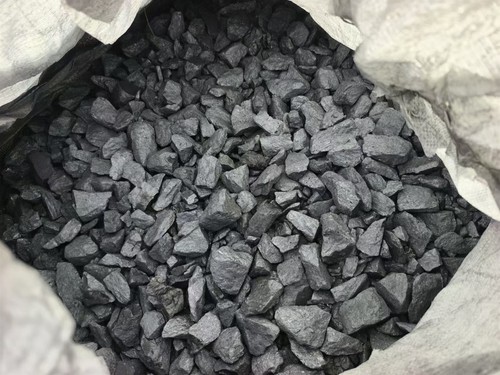
In the modern industrial field, ferro silicon is an extremely important ferroalloy, which is present in many industries such as steel, casting, and chemical industry. If you are curious about "What is ferrosilicon and what is its main use?", the following content will unveil its mystery for you.
Ferrosilicon is an ferroalloy with iron and silicon as the main components, and its chemical formula is usually expressed as FeSi. It is made by reducing silica (the main component is silicon dioxide, i.e. SiO₂) and iron ore (or scrap steel) with carbon in an electric furnace. The silicon content in ferrosilicon ranges widely. Common ferro silicon products contain 45%, 65%, 75% silicon, etc. The different silicon contents also give ferrosilicon different characteristics and uses.
In terms of appearance, Fesi is usually in lump or granular form, silver-gray in color, with a metallic luster on the surface, hard and brittle in texture, and has good electrical and thermal conductivity. In terms of chemical properties, the silicon element in ferrosilicon has strong chemical activity. In high-temperature environments such as steelmaking, it can react with oxygen, thereby playing an important role in deoxidation and alloying.

Main uses of ferrosilicon
Steel industry
In steel production, ferrosilicon plays a vital role and is an indispensable deoxidizer and alloying agent in the steelmaking process. During steelmaking, a certain amount of oxygen will dissolve in the molten steel, which will react with iron to form iron oxide, reducing the quality and performance of the steel. The silicon in ferrosilicon has a strong deoxidizing ability and can combine with oxygen in the molten steel to form silicon dioxide (SiO₂), which is separated from the molten steel in the form of slag, thereby effectively reducing the oxygen content in the steel, reducing the hot brittleness of the steel, and improving the quality and mechanical properties of the steel.
In addition, ferrosilicon can also be added to steel as an alloying agent to improve the strength, hardness, elastic limit, wear resistance and heat resistance of the steel. Ferrosilicon with different silicon contents can be used to produce different types of steel. For example, in the production of special steels such as high-strength low-alloy steel (HSLA), stainless steel, and heat-resistant steel, ferrosilicon is an important alloy additive. In the production of electrical steel (also known as silicon steel sheet), the silicon content has a decisive influence on its electromagnetic properties. By precisely controlling the amount of ferrosilicon added, electrical steel with excellent electromagnetic properties such as low iron loss and high magnetic induction can be produced, which is widely used in power equipment such as transformers and motors.
Foundry Industry
In the foundry industry, ferrosilicon is mainly used as an inoculant and spheroidizer. When molten iron solidifies, coarse graphite flakes and uneven structures are easily produced, which affect the performance of the casting. Ferrosilicon, as an inoculant, is added to molten iron to promote graphitization, refine graphite grains, improve the structure and properties of cast iron, and improve the strength, toughness and processing performance of castings. For example, in the production process of gray cast iron and ductile iron, adding an appropriate amount of ferrosilicon inoculant can make the graphite in the cast iron more fine and uniform, thereby significantly improving the mechanical properties and performance of the castings.
In addition, in the production of ductile iron, ferrosilicon can also be used as a component of the spheroidizer, and used in combination with elements such as magnesium to promote the crystallization of graphite into spheres, further improving the strength and toughness of cast iron, and meeting the strict requirements of casting performance in different industrial fields.
Chemical Industry
In the chemical industry, ferrosilicon also has important applications. Ferrosilicon can be used to produce magnesium metal. The main production method of magnesium metal is the Pidgeon method, in which ferrosilicon, as a reducing agent, reacts with dolomite (the main component is calcium magnesium carbonate, CaMg (CO₃)₂) under high temperature and vacuum conditions to reduce the magnesium element in it. Magnesium metal is a lightweight metal with the advantages of low density, high specific strength and specific stiffness, and good electromagnetic shielding performance. It is widely used in aerospace, automobile manufacturing, 3C electronics and other industries.
In addition, ferrosilicon can also be used to produce silicides. For example, ferrosilicon reacts with aluminum to produce silicon-aluminum alloy. This alloy has good casting and mechanical properties and can be used to manufacture automobile engine cylinder blocks, cylinder heads and other parts; ferrosilicon reacts with calcium to produce silicon-calcium alloy, which is a highly efficient deoxidizer and desulfurizer and is also widely used in steelmaking and casting industries.
Other fields
In addition to the above-mentioned main application areas, ferrosilicon also has certain uses in other industries. For example, in non-ferrous metal smelting, ferrosilicon can be used to refine and purify certain metals, remove impurities, and improve the purity and quality of metals; in the powder metallurgy industry, ferrosilicon powder can be used as an additive to manufacture high-performance powder metallurgy products, such as mechanical parts, tools, etc.; in the refractory industry, ferrosilicon can be used as an additive to improve the strength, corrosion resistance and oxidation resistance of refractory materials.


Depending on the field of use or the products produced, the size of ferrosilicon has many forms: natural ferrosilicon lumps, processed ferrosilicon lumps, ferrosilicon granules, ferrosilicon powder, and common size distributions include 0-3mm, 3-8mm, 10-50mm, 10-100mm, etc.
Ferro silicon plays an irreplaceable role in many industrial fields due to its unique chemical composition and physical and chemical properties, and is an indispensable and important basic material in modern industrial production. With the continuous development and progress of industrial technology, the application field of ferrosilicon is also expanding, and it is expected to show its unique value in more emerging fields in the future.