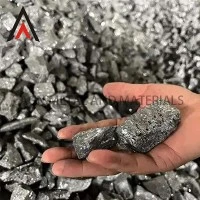
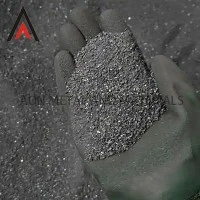
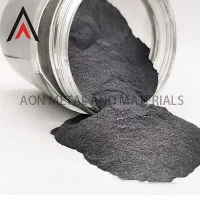
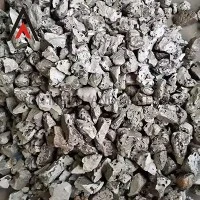
Calcium silicon alloy (CaSi) is a highly efficient composite refining agent in the metallurgical industry. Through the synergistic effect of silicon (Si) and calcium (Ca), it achieves deep deoxidation, desulfurization, and inclusion modification, directly determining the purity of molten steel and the overall performance of the steel. It is a core auxiliary material in the production of mid-to-high-end steel.
Core Advantages: High deoxidation and desulfurization efficiency, excellent inclusion modification effect; deep refining can be achieved with an addition of only 0.2%-0.5% per ton of steel, making it the preferred composite refining agent for high-end steel production.
Form and Packaging: Blocks (suitable for ladle refining), calcium silicon powder/cored wire (suitable for continuous casting processes), packaged in moisture-proof iron drums or ton bags; international transportation requires sealing to prevent oxidation.


Deoxidation Principle and Quantitative Effect of Silicon Calcium Alloy
(1) Core Deoxidation Mechanism: Silicon-Calcium Synergy, Deep Purification
Basic Deoxidation of Silicon:
Reaction Principle: Si + 2FeO → SiO₂ + 2Fe (spontaneous in molten steel at 1500-1600℃), SiO₂ has a much lower density than molten steel and easily floats to form slag;
Key Advantages: Mild deoxidation avoids violent boiling of molten steel, and the generated SiO₂ can form low-melting-point composite inclusions with other oxides (such as CaO・SiO₂), further improving separation efficiency.
Enhanced Deoxidation by Calcium:
Reaction Principle: 2Ca + O₂ → 2CaO, Ca + Al₂O₃ → CaO・Al₂O₃. Calcium has a stronger affinity for oxygen than silicon and aluminum, removing trace amounts of residual oxygen in molten steel while modifying hard and brittle Al₂O₃ inclusions.
Unique Role: The bubbles formed by calcium volatilization stir the molten steel, promoting the collision and flotation of inclusions, thus improving deoxidation uniformity.
Synergistic Deoxidation Effect:
Silicon first reduces the oxygen content in the molten steel, creating conditions for calcium deoxidation. The resulting Ca₂SiO₄ and other composite compounds further enhance deoxidation efficiency, improving it by 30%-40% compared to single silicon or calcium deoxidation.
Quantitative Effects by Scenario
| Steel Type | CaSi alloy addition amount | Initial oxygen content(ppm) | Oxygen content after refining(ppm) | Deoxidation efficiency |
|---|---|---|---|---|
| Ordinary carbon steel(Q235) | 0.2%-0.3% | 80-100 | 40-50 | 45%-60% |
| Low-alloy high-strength steel(Q355) | 0.3%-0.4% | 90-110 | 35-45 | 55%-68% |
| Stainless steel(304) | 0.4%-0.5% | 100-120 | 25-35 | 65%-79% |
| Alloy structural steel(40Cr) | 0.3%-0.4% | 85-105 | 30-40 | 58%-71% |


Desulfurization Principle and Quantitative Effects of Silicon Calcium Alloy
(1) Core Desulfurization Mechanism: Calcium as the Dominant Factor, Silicon as the Auxiliary Co-factor
Calcium-Dominant Desulfurization:
Reaction Principle: Ca + FeS → CaS + Fe (preferably in molten steel), CaS has a melting point of 2450℃, is insoluble in molten steel, precipitates as solid particles and floats to the slag;
Key Advantages: Calcium has a very strong affinity for sulfur, and its desulfurization capacity is 5-10 times that of manganese, reducing the sulfur content in molten steel to below 0.01%.
Silicon's Auxiliary Role:
Reduces the surface tension of molten steel, promotes the collision and aggregation of CaS particles, and accelerates their floating and separation;
Reduces the oxygen content in molten steel during deoxidation, reducing the interference of oxygen on the desulfurization reaction (avoiding the generation of SO₂), and improving the conversion rate of the desulfurization reaction.
(2) Quantitative Effects by Scenario
| Steel Type | SiCa alloy addition amount | Initial sulfur content(%) | Sulfur content after refining(%) | Desulfurization efficiency | Core value |
|---|---|---|---|---|---|
| Ordinary carbon steel(Q235) | 0.2%-0.3% | 0.03-0.05 | 0.015-0.025 | 30%-50% | Avoid thermal brittleness |
| Low-alloy high-strength steel(Q355) | 0.3%-0.4% | 0.02-0.04 | 0.008-0.015 | 55%-70% | Improve weldability |
| Stainless steel(304) | 0.4%-0.5% | 0.015-0.03 | 0.003-0.008 | 70%-85% | Enhance corrosion resistance |
| Wear-resistant steel(NM450) | 0.3%-0.4% | 0.02-0.04 | 0.006-0.012 | 65%-80% | Improve wear resistance |
Key Factors Affecting Deoxidation and Desulfurization Effects and Practical Control
Steel temperature: The optimal reaction temperature is 1500-1600℃. If the temperature is too low (<1450℃), the reaction rate decreases; if the temperature is too high (>1650℃), calcium volatilization loss increases.
Addition method: The wire feeding method (calcium silicon cored wire) is used in ladle refining. The addition uniformity is good, and the deoxidation and desulfurization efficiency is 15%-20% higher than that of direct feeding.
Initial oxygen and sulfur content in the steel: When the oxygen and sulfur content is too high, the amount added should be increased appropriately or added in stages to avoid insufficient reaction.