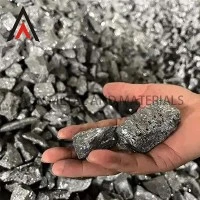
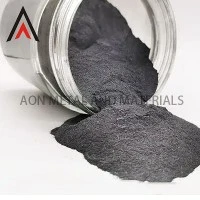
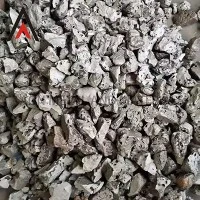
Ferrosilicon powder, as a refined form of ferrosilicon, leverages its high specific surface area and strong reactivity to achieve "precise functional adaptation" in steelmaking, casting, welding, and chemical industries. Its size control and composition regulation directly determine its application effects, making it an indispensable refined functional material in industrial production.
FeSi powder is made from FeSi through grinding/atomization:
Core components: Mainstream grades FeSi75 powder (Si 72%-80%, Fe 20%-28%), FeSi70 powder (Si 68%-75%, Fe 25%-32%), impurities Al≤1.5%, S≤0.05%, P≤0.04%;
Physical properties: Melting point 1250-1350℃, density 6.9-7.1g/cm³, size range 50-400 mesh (corresponding to 300μm-38μm), specific surface area 1-5m²/g, high-temperature reactivity 30%-50% higher than block ferrosilicon;
Core advantages: Uniform dispersion, fast reaction speed, precise function, suitable for refined production needs, achieving "small quantity, high efficiency" deoxidation and alloying effects;
Form and packaging: Powder (50-400 mesh) (Mesh) and atomized powder (sphericity ≥ 85%) are packaged in moisture-proof valve bags (25kg/bag) or ton bags. Vacuum moisture-proof treatment is required for international transportation.


In the field of steelmaking, ferrosilicon powder is an important deoxidizer and alloying agent.
As a deoxidizer
FeSi powder is added to molten steel during the steelmaking process. Due to the strong chemical affinity between silicon and oxygen, ferro silicon powder can quickly react with oxygen in the molten steel to generate compounds such as silicon dioxide. , thereby effectively reducing the oxygen content in molten steel and improving the quality of steel. For example, when producing high-grade alloy steel, the deoxidation effect of ferrosilicon powder can prevent defects such as pores and looseness in the steel and improve the density of the steel.
As an alloying agent
Ferrosilicon powder is fed into the molten steel together with other alloys, and is evenly distributed through stirring and other methods. The silicon is integrated into the steel, which can significantly improve the strength, hardness and elasticity of the steel. powder Ferrosilicon is often used as an alloying agent when smelting structural steel, tool steel, spring steel and silicon steel for transformers.

In the iron-making process, ferrosilicon powder plays the role of inoculant and spheroidizing agent.
During the specific operation, add ferrosilicon powder to the molten iron and stir evenly quickly. It can effectively promote the precipitation and spheroidization of graphite, thereby improving the performance of cast iron. For example, in the production of ductile iron, ferrosilicon powder helps the graphite to be evenly distributed in the cast iron matrix in a spherical shape, greatly improving the mechanical properties of the cast iron, greatly improving its tensile strength, toughness and ductility, which meets the needs of machinery manufacturing, automobiles There is a demand for high performance of cast iron materials in industry and other fields.
In the welding rod manufacturing industry, ferrosilicon powder can be used as a coating for welding rods.
Stir the ferrosilicon powder with other raw materials evenly to make a coating and apply it on the surface of the welding rod, which helps to improve the performance of the welding rod, make the welding process more stable and the weld quality is better.

In other industries, it can be used as suspension phase and product raw materials
In the mineral processing industry, ground or atomized ferrosilicon powder can be used as a suspended phase to help improve the efficiency and accuracy of mineral processing.
In the chemical industry, high-silicon ferrosilicon powder can be used to manufacture silicone and other products, providing important raw materials for the production of chemical products.